
I’ve been having a thought experiment with a buddy of mine, about how many of the original members in a band should still be in the line-up for that band to still be that band.
Like most things in life, to sort this one out we have to look at history.
History lesson #
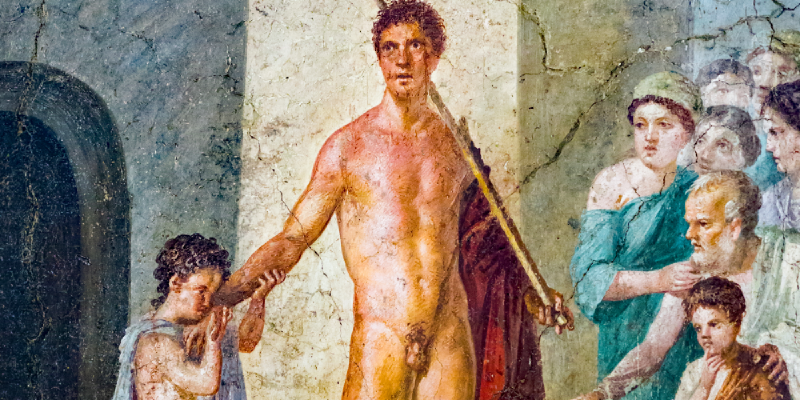
In ancient greece, the hero Theseus, rescued some Athenian kids from King Minos (after slaying the famous Minotaur in Daedaluses maze) and brought them to safety on a ship toward Delos. The Athenians were so over the moon about this heroic act that they decided to commemorate this event yearly by taking a pilgrimage on said ship to Delos to honour Apollo (not the famous stand-up venue, but the god.).
Over time the wooden-built ship started to rot and decay and pieces of the ship were replaced to keep it seaworthy. Some ancient philosophers saw this and ,due to them being philosophers, raised the question: “If no pieces of the original ship remain, is it still the same ship?”. Pilgrims: stumped.
Seventeenth-century philosopher Hobbes went even further (as by that time, most of the thinking was already done, and he was pulling at straws) and asked: “What if we built a ship from the removed pieces, would that then be a second ship of Theseus?”. Hobbes accidentaly discovered the infinite money-glitch of shipbuilding.
The solution #
The big boys over at Stanford University have put together an “Encyclopedia of Philosophy”, wherein they put that the most accepted resolution to the problem is that the individual parts of the ship do not make the ship. The two objects simply occupy the same space at the same time. (It’s more than that, but that’s the gist of it.)
Fair enough for a ship, but what about bands?
The bands #
The discussion started after hearing Linkin Park’s new output with Chester Bennington’s replacement vocalist Emily Armstrong. No notes on the song itself, but the question arose about how big of an integral part Chester’s voice was to the sound of Linkin Park as a band. You could hear Emily trying to replicate Chester’s vocal range and timbre in the first live show when they played old Linkin Park material, and it just sounded… off. This of course could just be a me-problem, being used to hearing it one way, and then suddenly hearing it another.
Then there’s Blink 182, only 3 members, of whom 2 are vocalists. They did start new bands: there was Box Car Racer with the tandem Barker/DeLonge and +44 with Barker/Hoppus. According to Hobbes both these bands are probably also Blink 182. (Yes, I know, +44 was a post-Blink-Breakup band, and BCR was a side project with material unsuited for Blink 182’s vibe, don’t @ me Dammit.)
Speaking of Hobbes, he’d love the Sugababes. The original members got replaced over the years, but when those replacements called it quits the founding members just restarted Sugababes again in the original setup. Round Round indeed.
You could also look a little Closer at Nine Inch Nails. A band that’s de facto Trent Reznor + Others (and since 2016 Atticus Ross) You can take any of the other members and replace them, let them make another band, and that band (w)/(c)ould never be Nine Inch Nails without Trent Reznoring it up.

The White Stripes have only 2 members, but you couldn’t have the band without the duality of Jack White’s guitarwork next to Meg Whites toned down minimalistic drumming. Both are equal parts that comprise of the sound of the band. No matter what the haters say.
So here’s the big question: when does a band stops being a amalgamation of it’s members, and how big of a part are the members in the sum that is that band?
My personal theory is that the importance of band members lie in:
-
The writing process #
In case of for example The White Stripes there is nothing hard (or so I’ve been told) about playing the drum-lines of any given track. What I think is the hard part for Meg White is the reeling in of Jack’s almost over the top guitar work, and bringing him to a point of minimalism where his genius gets more breathing space by omiting the fluff and showcasing the essentiality of his talent.
Nine Inch Nails wouldn’t work without Trent Reznor, because he is the band. It’s his vision manifested through session musicians.
-
The technique of performing. #
This one is a little thougher to pin down. There’s the obvious part of vocals, where a voice is hard to replace just because of the uniqueness of it. You can find a vocalist in the same range, but it will never be an exact carbon copy of the original. Then there’s the instrumental aspect. You could take the same setup of amps and pedals, or the same drumkit and get the exact same sound, most of the time. Other times there’s a specific way of playing that just can’t be emulated. You can’t put just any drummer in Tool’s Danny Carey’s seat and expect to hear the same long drumsolo.
The conclusion (or lack of) #
There’s no single way of quantifying why a band is a band. I’d say you have to score the individual members of the band in both writing-contributions and sonical-contributions.
This is a fictional band:
| Member | Writing | Performing | Total |
|---|---|---|---|
| Drummer | 0 | 0 | 0 |
| Guitarist | 25 | 25 | 50 |
| Bassist | 0 | 0 | 0 |
| Vocalist | 25 | 25 | 50 |
| Total | 50 | 50 | 100 |
So you could say that you could replace the drummer and the bassist who both contributes nothing to the songwriting, and have no significant sonic uniqueness.
The Writing column is quantifiable, you can look up writing credits and divide it by the total number of songs and get a proven importance of a certain member in number form. The Performing column on the other hand is just vibes. You can’t scientificaly pin down a percentage of the contribution of a specific band member to the overall sound in a blanket theory. You’d have to look at it on a band per band basis.
Then there’s also the problem of the threshold of when it’s okay when to replace a member. Do you need 50% left? 75%? Some bands are easy, like NIN, where Trent Reznor comprises of nearly 100% on his own. Some are a little grayer like Linkin Park. You have Mike Shinoda as writer and composer, but you’ve lost vocal powerhouse and de facto lead-singer Chester with his irreplaceable vocal sound and range. Is Joe Hahn replaceable as turntablist? They also changed drummers, in what capacity does that affect the sound of the band?
And that’s where I’m stuck. The performing part is down to taste, and you can’t put a number on taste.
To conclude the conclusion:
I get that it would be stupid for remaining members of a band to start a new band in most cases, as the recognition of the name still very much outweighs any philosophical qualms you could have with them using that name. Linkin Park is still Linkin Park, they just sound a little bit different now.
The Wiener Philharmoniker started out in 1842 and still plays to this day. None of the original members are on the roster today. You could say that they are a cover band, as they don’t play their own songs, but the point I’m trying to make is that a bandname could also be seen as a quality label. No matter who is on the roster, you know what kind of show you can expect.
I could dive deeper into this, But in the end, it doesn’t even matter.
TO-DO: PUT THIS DISCLAIMER AT THE TOP OF THE ARTICLE
Edited after publication to add some typos.